Work · Immersive · 2025 · Client anonymised
Immersive-theatre & murder-mystery chain · narrative engine and store systems
A data foundation and a dedicated model for an original story world — leak-proofing, playtesting, rewriting and expanding scripts; live across multiple venues
Starting point
The client is a Chinese immersive-theatre and murder-mystery chain that writes its own original work and runs the whole pipeline in-house — writing, playtesting, publishing and running the shows in its venues. A single title can carry dozens of characters, more than a hundred events and several hundred hidden truths, all of which used to be kept consistent on paper by the writers themselves.
The problem
- Leaks: in live playtests a player would get a clue they should not have had in that act, or a character would let one line slip — one truth revealed early and the whole session collapsed.
- Playtesting by headcount: the only way to check a script's logic was to seat a full table of people and run it round after round, fixing and re-running each time.
- One change touches everything: editing a single event meant chasing every place it affected, then re-reading the original script again and again to check the result.
- Expanding is half a rewrite: adding one character meant inventing relationships, secrets and something to do in every act — without them becoming dead weight.


What we built
- 01We first digitised the story world: characters, events, causal links, and what each person knows or is kept from in each act — all structured into one causal event graph that everything else runs on.
- 02Leak-proofing: each character goes on stage carrying only what they should know in that act — what they should not know is structurally out of reach. A writer can interrogate any character one-on-one and gets answers only from what that character is allowed to know.
- 03Playtesting: several characters confront each other on stage, each guarding their own secrets; the writer's view shows every character's private reasoning and who is hiding what.
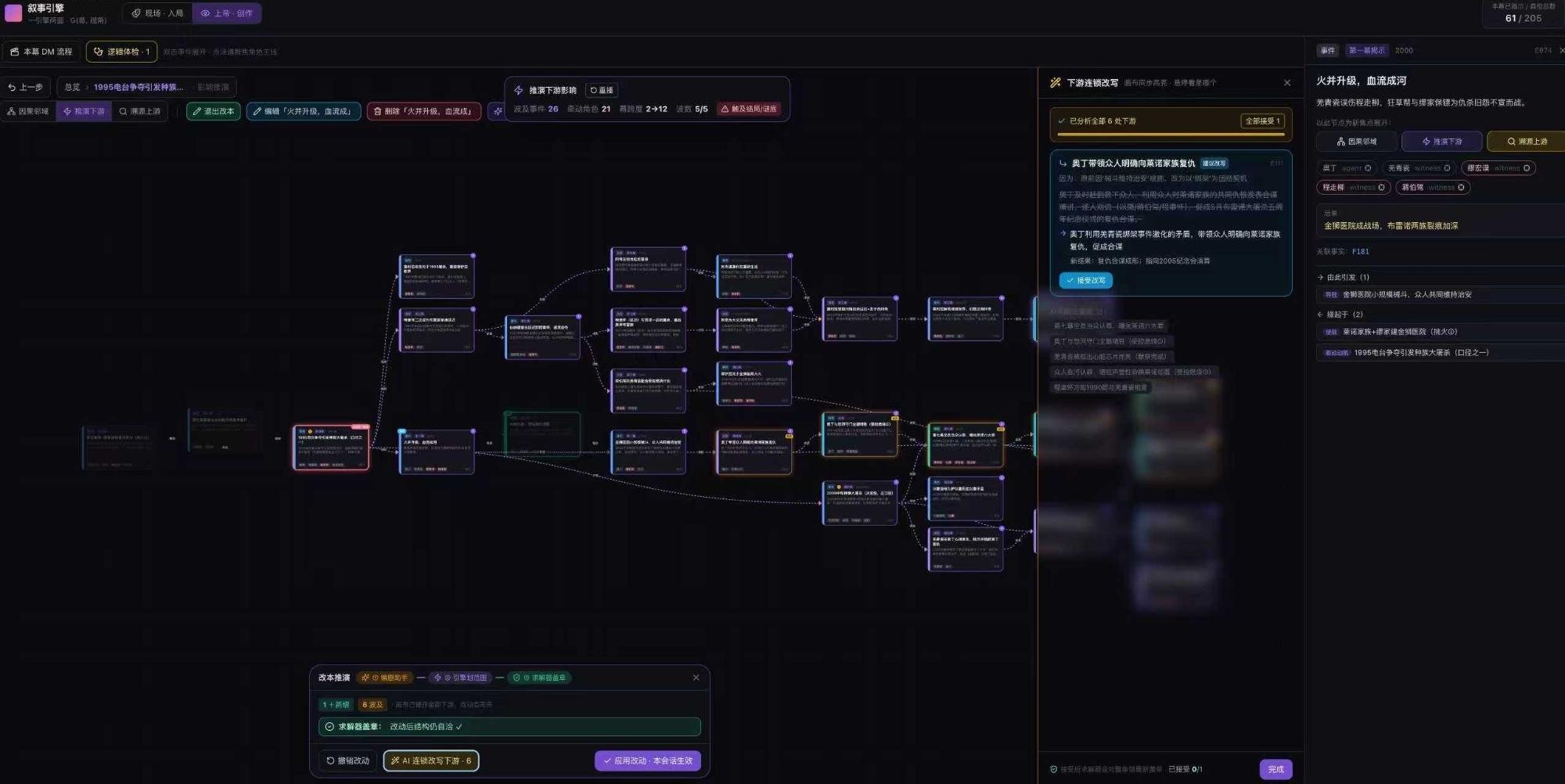
- 04Rewriting: change one event and the system traces the causal graph downstream, marks every affected event, character and act, then proposes rewrites that make the downstream consistent again — each one accepted or rejected by the writer.
- 05Expanding: when a new character is added, the system stays inside the existing world and drafts their wants, secrets, ties to existing characters and the events they are drawn into.
- 06On the venue side, a customer-lead management system brings each store's leads and follow-ups into one place.
- 07The whole system keeps people in the loop: AI checks, traces and suggests; emotion, warmth and how the story turns are always the writers' call.
Technology
Causal event graph · per-character knowledge isolation · multi-agent staged confrontation · downstream impact tracing and chained rewrites · a model dedicated to the story world
Outcome
Multiple venues
in live use across the client's venues (multiple stores)
“Changing a script used to mean the whole team re-checking the logic. Now the system finds the holes first and we just write.”
Next case
Enterprise AI deployment for a leading medical-aesthetics MCN